In Education, Nothing Happens in Isolation

I have said this before in previous blog posts and if you think about it, it makes sense, right?
Let’s walk through the idea.
Think about a regular school day. Let’s make it sunny with a nice temperature. Students arrive from different cultural and socioeconomic backgrounds (and we already talked about how strong these variables can be in predicting student achievement). They walk into classrooms with different teachers. In one school, that repeats across grade levels. Then multiply that across schools. And for middle and high school students, the classroom changes every period.
All of the components from the example carry some level of influence on how students are learning. You know that. We know that. Then we add regular instruction. And in the federal programs world, we layer on supplemental interventions. Multiple strategies, supports, and targeted services on top of core instruction. And for those interventions, we want to know the impact. We want to understand whether intervention X actually influenced student learning and achievement.
Now here’s the caveat when we look at this from a districtwide perspective.
We often default to familiar statistical tools like t-tests or ANOVAs. At their core, these methods are about partitioning variance. And variance is simply a way of describing how much students differ from one another in their outcomes.
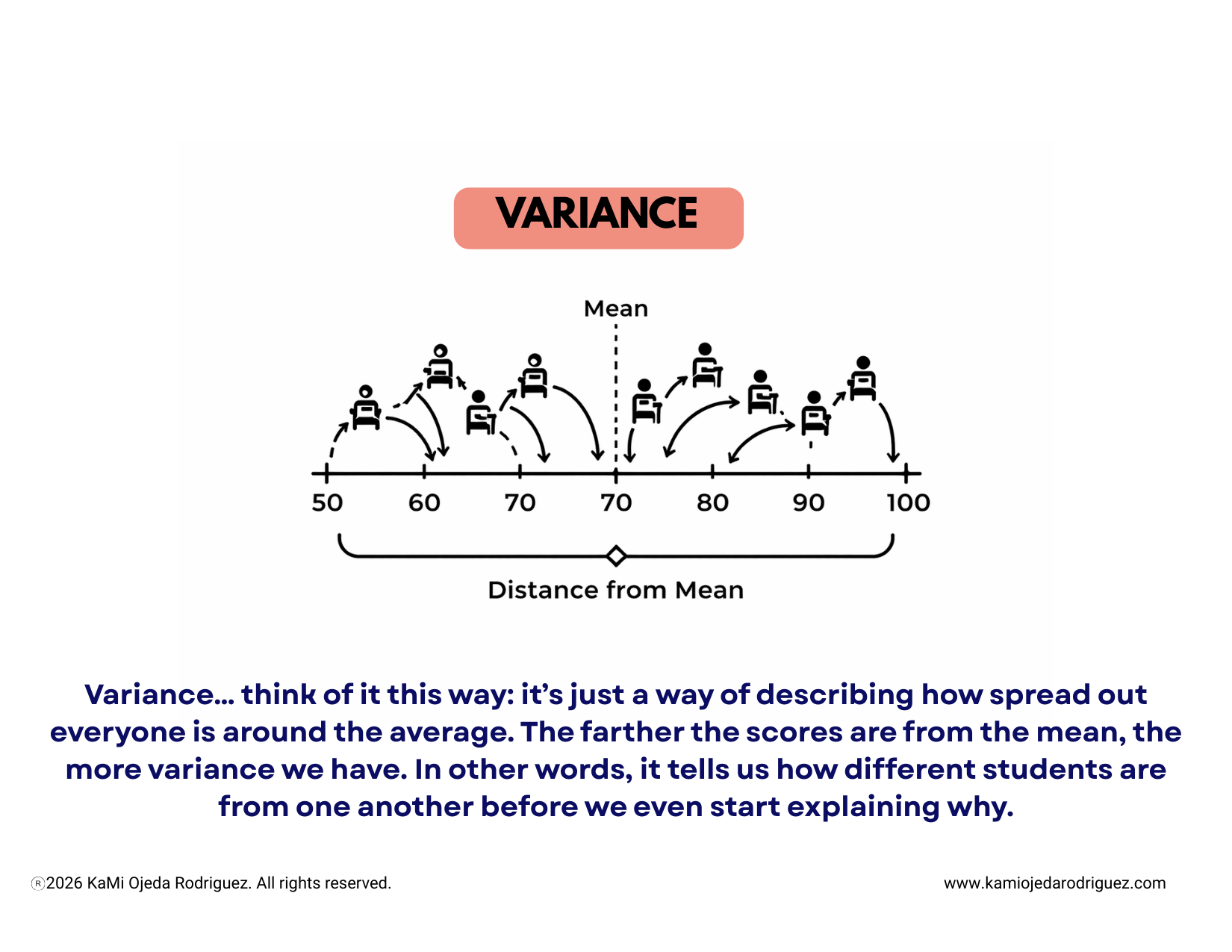
When we analyze data, we are essentially asking: where are the differences coming from? How much of the variation in achievement is associated with one factor versus another? Traditional parametric tests divide that variation in certain ways. But they rely on a very important assumption: independence of observations.
What does that mean in plain terms? It assumes each student is completely independent from every other student. No shared teachers. No shared classrooms. No shared schools. No shared environment. And we already know that’s not how schools operate.
Students are nested within classrooms. Classrooms are nested within schools. Those nested structures mean students share experiences and conditions. So part of the variance in outcomes may be due to individual characteristics, and part may be due to the classroom or school they belong to.
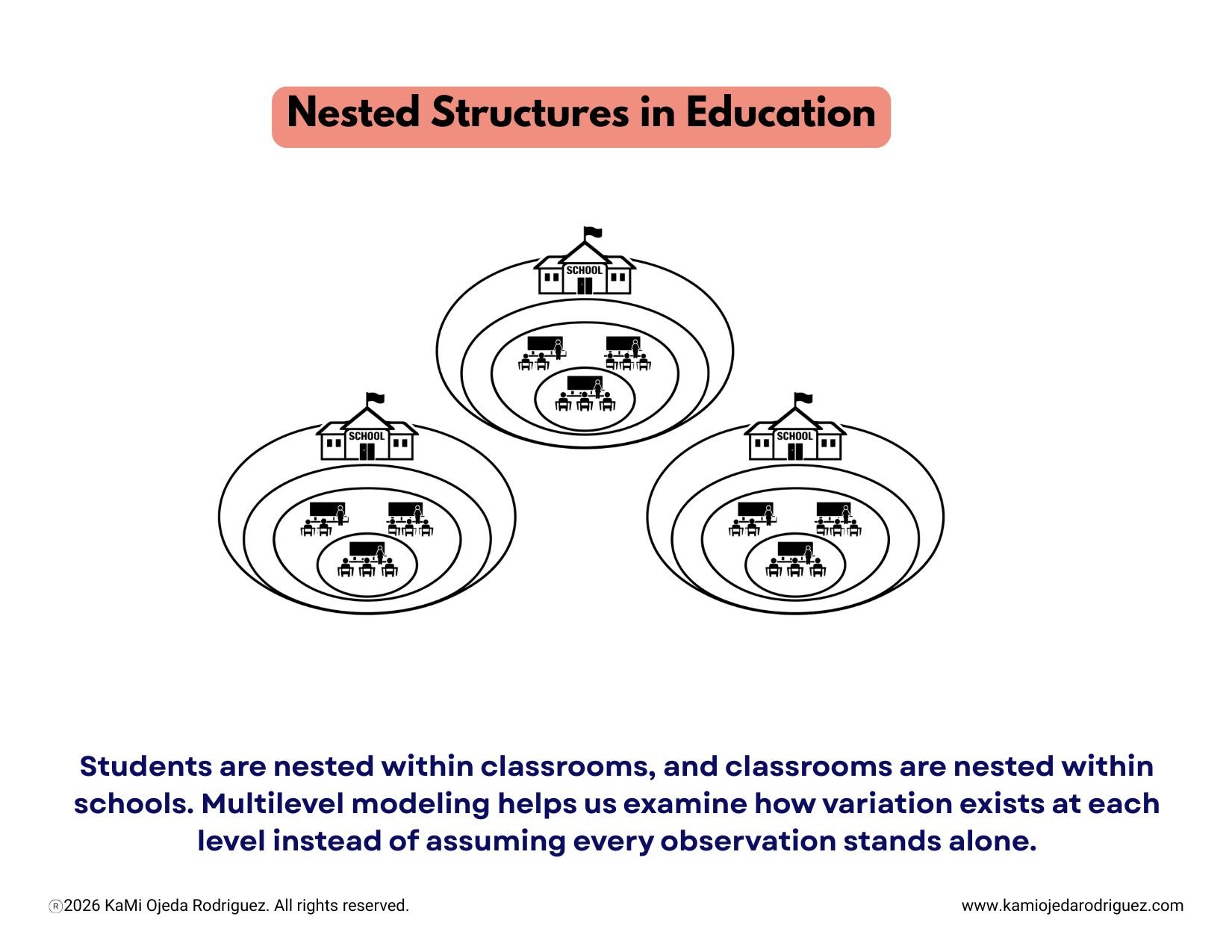
If we ignore that structure, we misattribute where differences are actually coming from.
This is where multilevel modeling becomes powerful.
Instead of forcing all the variance into one level, multilevel models explicitly partition it across levels. We might begin with a random intercept model. In technical terms, this allows each school to have its own average outcome. We estimate something called the intraclass correlation coefficient (ICC), which tells us how much of the total variance lives between schools versus within schools. In simpler terms: do schools meaningfully differ from one another, or are most differences happening among students inside the same school? That alone can shift how we interpret districtwide data.
Then we can introduce random slopes. That means the relationship between a predictor and an outcome is allowed to vary across schools. A variable might be strongly associated with achievement in some schools and less so in others. Instead of assuming one uniform effect, the model acknowledges variability in that relationship.
And then we can go further with cross-level interactions. This is where a student-level characteristic interacts with a school-level factor. In plain terms, context shapes how individual characteristics relate to outcomes. The same student-level variable may operate differently depending on the school environment.
All of this comes from a particular class. This semester I’m taking multilevel modeling, and I won’t lie: I’ve been quietly excited about it for a while. I always knew this layered reality existed in our data, but I didn’t yet have the tools to model it properly.
Now that I’m learning it, there’s something empowering about watching the variance shift as levels and interactions are added. It’s like peeling back layers of a system and seeing where differences exist.
Multilevel modeling helps make the structures visible, and that visibility feels empowering.