CNA January Series: Using CNAs to Guide Budget Decisions

In the first post of this CNA series, I focused on moving from data review to root cause analysis. I started with these two steps because together they form the backbone of a strong CNA. But once that part of the process is complete, what comes next? That’s when my budget people start having fun, because planning and funding allocation officially begin.
Budget development happens alongside many other planning considerations, including staffing, allowable expenditures, targeting evidence-based interventions, and working within required timelines. These are all complex processes, and CNAs are just one of several inputs that inform them. Still, when done well, a CNA strengthens that input by providing a focused rationale for how resources can be aligned to priority needs within existing parameters.
A Title I Example of What Alignment Should Look Like
The image below illustrates one example of how this alignment is intended to work at the school level in a Title I context. With some adjustments, the same general approach can be applied to programs and district-level initiatives by switching out the names of the plans.
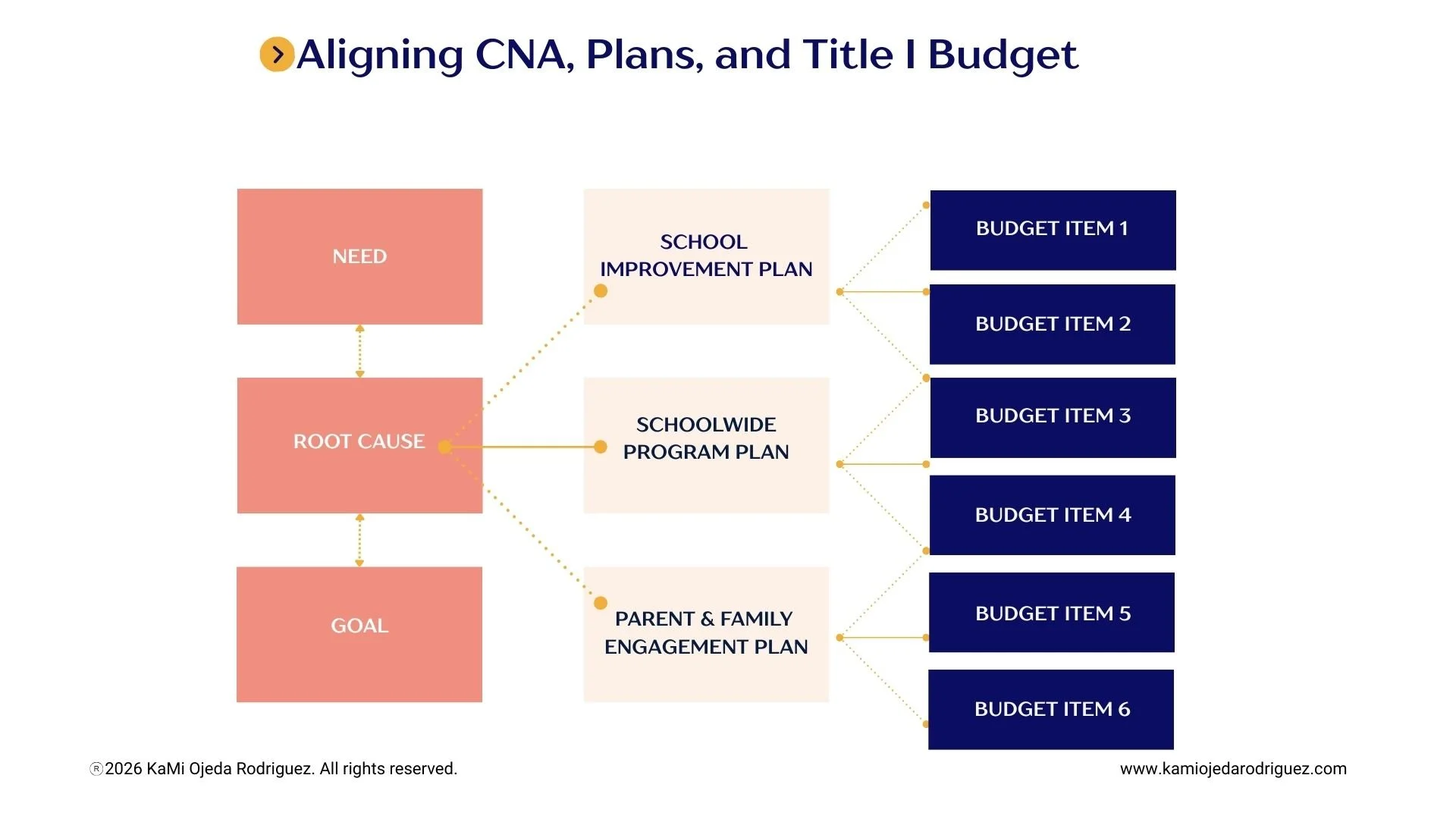
In this example, the process starts with a defined need, grounded in data and refined through root cause analysis. That root cause then informs goal setting and flows into required planning documents such as the School Improvement Plan, the Schoolwide Program Plan, and the Parent and Family Engagement Plan. I know it sounds intuitive to plan around goals, because of course we want to accomplish something. But I want to gently challenge that mindset and ask you to think about how plans are actually addressing root causes. Root causes represent the conditions that are within a school’s control to change. When plans are designed to address those conditions, goals are influenced in a more direct and meaningful way.
Only after those plans are aligned does the Title I budget enter the picture. Each budget item connects back to a strategy within the plan, and each plan connects back to the root cause identified in the CNA that is driving the goals. This is not about checking boxes or matching language across documents. It is about the logic behind budget decisions. A budget line should exist because it addresses a specific condition identified through the CNA.
Another way to articulate this level of alignment more formally could be through a comprehensive logic model. I have always been curious about developing logic models for Title I schoolwide programs. I have not had the chance to do that yet, but it is something I keep coming back to.
Why Root Cause Changes Budget Conversations
Going back to the reading example from the first post, identifying “low reading proficiency” alone leaves schools with too many possible directions, including tutoring, new curricula, software, staffing changes, and professional development. All of them sound reasonable but with a root cause clarified, the decision space gets smaller. If the analysis shows that reading challenges are concentrated in early grades and align with inconsistent implementation of foundational practices, then budget conversations can shift toward two specific areas of opportunity. This means strengthening those instructional conditions that schools can influence for the specific grade spans showing the decline. This is how the CNA provides the foundation for budgeting in practical ways. Root cause analysis does not tell schools exactly how to spend funds, but it does help determine what not to prioritize.
How Alignment Looks Like in Practice
In a Title I context, alignment can be identified when funding decisions can be clearly connected back to the needs identified through the CNA. It simply requires being able to explain, in practical terms, why a particular expenditure exists and how it’s being used to support the work the school is trying to improve (aka, the need). There are two main questions you could ask to help anchor this thinking. First, what condition identified in the CNA is this expenditure intended to address? Second, how does this investment support a change in practice or support that is connected to that condition? If you can look at the federal programs budget and answer these questions, then you have reached alignment because the CNA is actively informing implementation rather than sitting apart from it.
You can have multiple budget line items allocated towards the highest priority need; in fact, alignment does not equate to one-to-one matches between needs and line items. Alignment means that when you are allocating funds, you are thinking strategically the use of funds. For instance, a single instructional need could be supported through professional learning (PL) for instructional staff, substitutes to cover classrooms while the staff attends PL, and perhaps instructional materials. The result is a strategic allocation of funds targeting one area of need coherently, not through one-to-one mapping.
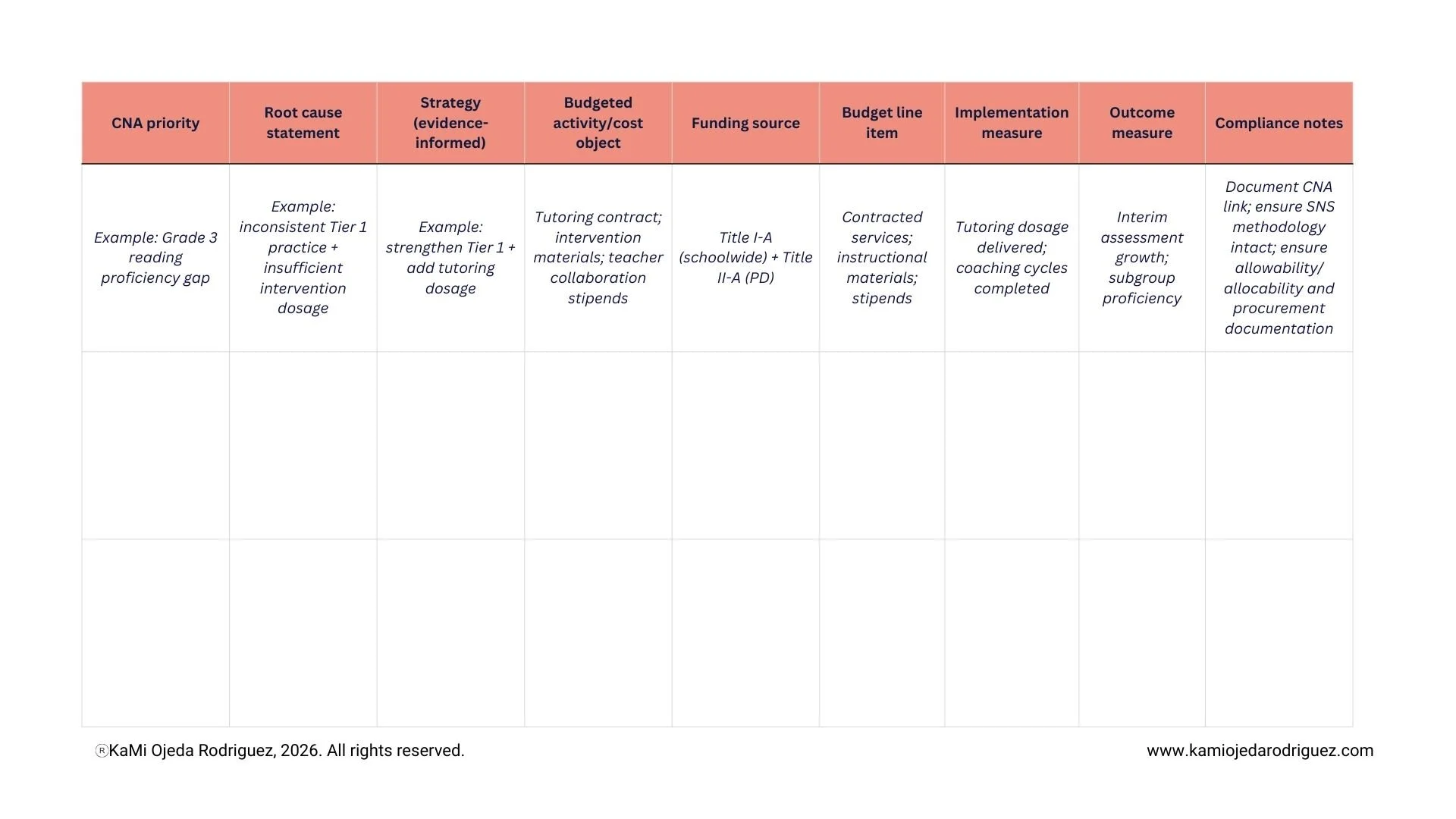
Here is an example:
Tracing a CNA priority through root cause, planning, budgeting, implementation, and outcomes in a Title I context.
A Closing Reflection
Every year during CNA season, I see that the hardest part of this work is making sense of everything at once. Data, root causes, plans, budgets, timelines, all moving in parallel at their own pace. What I have learned overtime is that CNA works best when is treated as a way of thinking, not just a step to complete. With clearly articulated root causes, then the planning feels less scattered, and budgeting conversations feel more grounded. That’s what this post is really about: using the CNA process to create a clear image for planning and budgeting decisions. When that clarity is there, alignment across plans and resources follows more naturally. The CNA stays part of the conversation instead of becoming something we revisit only when required.